The Five-Pound Jacket: Why Sunday Car Boots Are Britain’s Sharpest Style Classroom
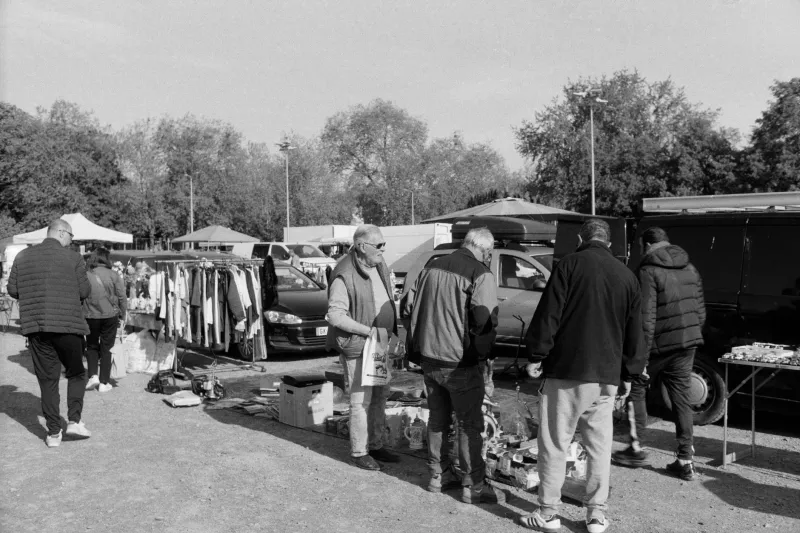
There is a particular kind of British morning that begins in a leisure centre car park, breath visible, flask in hand, while somebody unloads a folding table of leather jackets from the back of a hatchback. It is not glamorous. It is not curated. And that, increasingly, is the point.
Car boot sales have always been part jumble sale, part theatre, part mild social experiment. But something has shifted. Younger shoppers are turning up earlier, looking harder and treating the Sunday boot fair less like a novelty and more like a proper style education. In an age of same-day delivery and infinite scroll, the appeal is almost rebellious: you cannot search for what you do not know exists.
The opposite of the algorithm
Most online shopping starts with a want. A car boot starts with a table. You arrive with a vague list, maybe a good coat or a sturdy mug, and leave with a 1970s ceramic jug, a wool blazer that smells faintly of cedar and a paperback you did not know you needed. The lack of curation is the whole charm.
For younger shoppers, that unpredictability is a sharp alternative to fast fashion. The rail is not arranged by trend or colour story. It is arranged by whatever survived the loft clear-out. You have to look, touch, turn things over and make a judgement. That is a different set of skills from tapping ‘add to basket’, and it is one worth having.
There is also the green arithmetic. Buying second-hand does not solve every problem in the fashion system, but it does keep a wearable jacket in use for another decade rather than sending it to landfill. And a good car boot find tends to be looked after because it feels like a discovery, not a transaction.
Field notes from the early shift
The first rule is not to arrive too early. Traders need time to set up, and hovering while someone is still untying boxes is not a good look. Aim for the first proper hour: enough choice, not so early that you are in the way. Bring cash, a sturdy tote and a loose idea of your measurements. A small tape measure in your bag has saved many a hopeful purchase.
Then slow down. The best stalls are rarely the neatest. A pile of coats on a groundsheet can hide a beautifully made trench; a box of kitchenware can contain a studio pottery mug worth more than the £2 asked. Check seams, zips and linings. Look at the grain of leather and the weight of a knit. Turn ceramics upside down for maker’s marks. Ask yourself whether you would wear it three times this month, not whether it is merely cheap.
Haggling has its own etiquette. A gentle ‘would you take £8 for these two?’ is fine. Badgering someone over 50p is not. If a seller says no, smile and move on. The car boot is a community before it is a market, and the people behind the tables are usually there because they enjoy the chat as much as the clear-out.
A different kind of fashion education
What you learn at a boot fair is tactile. You start to recognise the difference between a bonded leather jacket and one with real grain. You notice how a proper wool coat hangs. You understand why some shirts feel crisp and others go limp after two washes. That knowledge quietly improves everything else you buy, including the new things.
Styling second-hand is part of the fun. A boxy man’s blazer can become the best thing in a weekend outfit with jeans and a plain tee. A vintage silk scarf lifts a charity-shop trench. A chunky knit from a stall in a church hall works with tailored trousers and trainers. The trick is to treat the find as an ingredient, not a costume. Buy for the wardrobe you actually have, then let one odd piece do the talking.
The green arithmetic
Britain sends vast quantities of clothing to landfill every year, much of it still wearable. Car boot sales are not a complete answer to that, but they are a practical one. They extend the life of things that were made well enough to last. They also put money directly into the hands of people clearing out, rather than into a faceless supply chain.
There is a lovely honesty to the whole exchange. Nobody is pretending a £5 jacket is new. The slight wear on the cuff is part of the story. The fact that it has already survived one owner is a decent sign that it might survive you too.
Start small this Sunday
With the colder months settling in, outdoor pitches are giving way to indoor sales in church halls, community centres and school gyms. The etiquette is the same, only warmer. Set yourself a modest budget, perhaps £20, and one rule: buy only what you can carry home comfortably and would genuinely wear.
Take a friend, take a flask, take your time. The car boot does not reward urgency. It rewards attention. And somewhere between the mismatched crockery and the rack of slightly hopeful coats, there is usually a five-pound jacket with your name on it.